How to Study Your Bible: part 1
Studying Scripture isn’t something we are born knowing how to do or something that comes automatically when we believe in Jesus. It’s a practiced skill! So if you feel a little lost when it comes to studying your Bible – guess what?! You are not alone!
In the next few weeks I am going to cover a treasure trove of tools that can help you understand and apply Scripture better. Some of these tools will feel almost “magical” (am I allowed to say that?). Some tools might not be your thing (or perhaps not for right now). In any event, I am confident you will be better equipped at the end of this study series to study God’s Word for yourself!
Let’s start with the obvious question – why do we want to study Scripture?
We live in a world where everything is super fast paced and slowing down to dig into Scripture feels really hard to our scroll-saturated, over-busied brains. I 100% get that! I hear you! So here’s a few reasons to push through the initial struggles of learning to study Scripture:
1. God calls us to love Him with all our heart, soul, mind and strength (Deuteronomy 6:5, Luke 10:27). For me, applying all my brain space/energy/focus to study Scripture is a way I can say, “I love You, Lord,” with all my mind. While there are lots of ways to love God with all our minds, this is the primary way I love Him with mine.
2. The more I study Scripture, the more Light I have to read it with ….When I study Scripture, it works like connecting dots that exponentially increase the Light I receive from the Bible (Psalm 119:105). For example, if I know nothing of the Old Testament and I read the genealogy of Jesus in Matthew (without studying it, just devotionally reading the text), it’s kinda boring. But if I know about the stories attached to each one of those people mentioned (annnnd since this is especially for women, I dearly love the women’s stories in that genealogy!) all the sudden there’s more light in those verses for me to carry throughout the day after my morning reading. Does that make sense? The more I know Scripture, the more and MORE I know the next time I read. And it snowballs. You start to connect the dots between Old Testament prophets, Genesis, the Psalms and Revelation and you have more and more Light for your path. It’s like a flashlight bulb. They are usually rather small. But surrounded by a reflector that makes the light more magnified and more efficient. This is how studying Scripture works in our lives – like a reflector piece around a little bulb.
As we dive into this Ruth study, we are going start with the very basics!
Bible Study Basics
1. Do you have a good study Bible?
I have the NASB Zondervan Study Bible but I also love The Key Word Study Bible. For our study, I will be using the NASB (1995), but you can use whatever you have!
A good study Bible will provide you with some great tools!
– First, there should be an introduction to each book. Before we jump into Ruth, read your introduction. Ruth is such a fun book to study because it’s loaded with Hebrew background information, beautiful literary features, and word meanings. A good introduction will give you a peek into these kinds of details. And its these details that simultaneously make passages confusing but once they are studied and understood, they are part of what makes the Bible so beautiful!
If you love overviews of Scripture, I highly recommend What the Bible is All About by Henrietta Mears. And full disclosure, I was gifted a children’s copy when I was about ten from a very special couple and I still have it and I actually still love it because the pictures are fun! If you teach kids this is a great resource to have and a great gift if you know a child that has a bent toward the Lord.
– Second, there will be footnotes and inner-column notes. These notes hold amazing keys to understanding Scripture and sometimes people go for years without knowing how to use them. So let’s unpack that here 🙂 In my study Bible, verse 1 has a teeny superscript 1 next to the word “governed.” Then on the inner-column, there’s a bold “1:1” with the phrase “or judged.” That inner-column note is letting me know that word “governed” could have been translated as “judged” instead. That particular tidbit isn’t terribly life changing, but there can be some very insightful language translation notes that powerfully change the way you might read a passage. In general, the inner-column notes will give you Bible verse cross-reference information (like hey, here’s the stories of the people in the genealogy or here’s other places in Scripture that mention similar topics or themes) and word meanings. Also, the superscripts will take you to those inner-column notes (not the notes under the Bible text). Sometimes the superscript is a number or a letter – that just helps keep it sequential and organized when you look in the column for the additional verses or information. We will practice this more in our Bible study class to make sure you’ve got it all squared away – I don’t want you missing any good stuff here!
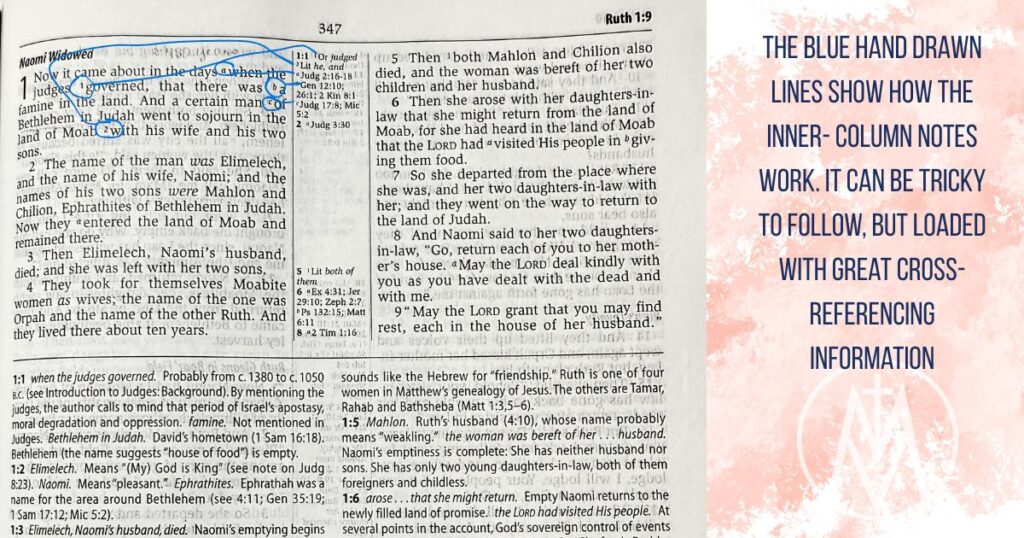
Understanding Bible cross-reference is particularly important so we get a full view of Scripture. It can be tempting to get wrapped up in one verse without understanding how that topic fits within the whole of Scripture. If we study a topic across the span of Scripture we will cultivate a more balanced view of Scripture! This is really important to our spiritual health!
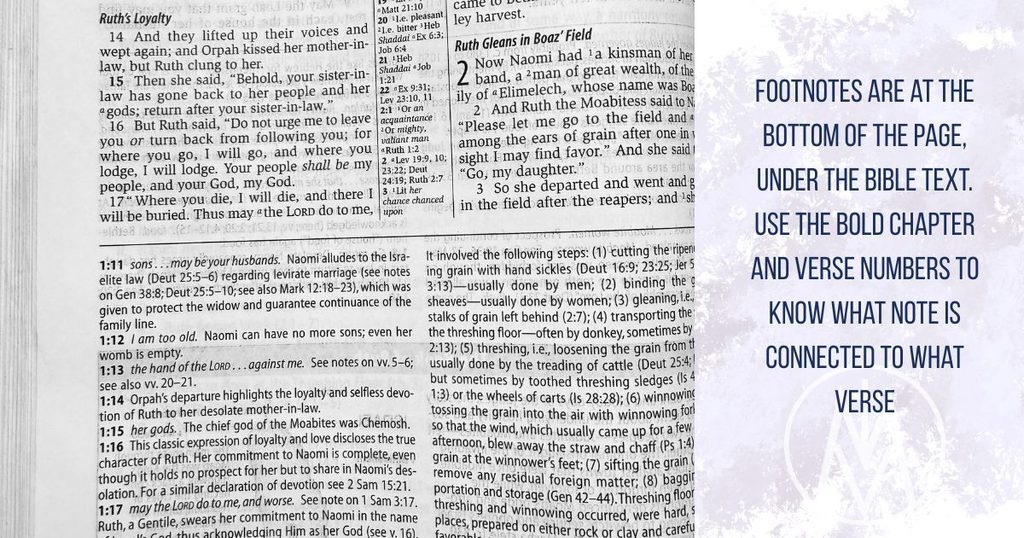
Footnotes aren’t attached with a superscript, but they will have a bold chapter and verse number with information about various selected verses. Sometimes the editors will provide word meanings, cultural background information, or interpretation.
– Third, there will be maps, charts, family trees – visual information to help you understand the text. For me, I have a map of the distance Naomi traveled. If you have a map in your Bible, use it! And consider what it must have been like for two women to cross all that terrain alone.
– Fourth, a good study Bible will have a concordance in the back. Some also have little Bible dictionaries. A concordance is a way of referencing word usage in the Bible. So, in my little concordance, I might look up Moab (where Ruth was from and where Naomi was leaving) to see where else Scripture mentions Moab. I have six passages outside the book of Ruth I could look up. If I look up those passages, I will get a much fuller picture of the Israelites relationship with Moab. Now, go and count how many times in the first 2 chapters Ruth is referred to as a “Moabitess.” When she is designated that way over and over, and I read the other passages about Moab and Israel’s relationship, I get a much fuller picture of her situation, don’t you? Does that help you relate to her more personally? It sure helps me understand her more and it also reveals God’s love and inclusion of people who are commonly outcasts (but want to follow God with their whole lives). The concordance will offer more cross-referencing capacity than the inner-column notes.
If you enjoy this type of word reference study, I highly recommend learning to use the (online) Blue Letter Bible or purchasing a (hardcopy) Strong’s Concordance. I love both the Strong’s and the Englishman’s Concordance (which works a little bit backwards from the Strong’s. So using both together helps you cover a lot of ground.) I use Olive Tree, a software program, that allows me to use all these fantastic tools digitally. It’s kinda pricey. But Blue Letter Bible has many of the same tools and its FREE! We will be using the Blue Letter Bible during our study time and I will be covering that tool soon 🙂
OK! So now hopefully we have covered the great tools that are probably sitting right at your fingertips in that big ol’ study Bible you carry around with you!
If you have any questions about using your study Bible, have them ready for me at our next class!